Sister M.E.
The Hot ZoneSister M.E. is a nun associated with Yambuku Mission Hospital during the 1976 Ebola outbreak in Zaire. Her illness brought the crisis from the hospital in the forest to Ngaliema Hospital in Kinshasa, and the effort to learn what was killing her produced tissue and blood samples that were sent to laboratories for investigation. The account gives little of her personal history; her place in the narrative is defined by the path of the disease through her, her transfer for care, and the specimens collected as she was dying.
At Yambuku Mission Hospital
The outbreak reached Yambuku Mission Hospital after an infected schoolteacher sought treatment there. The hospital’s routine injection practice created a possible route for transmission: staff used five hypodermic syringes for patients throughout the day, sometimes rinsing the needles but often moving from one injection to the next without doing so. The schoolteacher may have contracted the virus through an injection, although the account cannot establish this as the source. The first recognized case and the first infection in the chain therefore remain distinct questions: an unidentified earlier patient may have contaminated a syringe.
The disease spread beyond the hospital into surrounding communities and among its staff. Nurses were among those who fell ill, and the narrative describes a midwife who became infected after assisting at a delivery. It also identifies Sister M.E. as a nun at Yambuku who became gravely ill. The account does not clearly establish whether Sister M.E. was the midwife, so the two details do not warrant being treated as a confirmed identification. What is clear is that her illness belonged to the outbreak affecting both the hospital and the people who cared for its patients.
Transfer to Kinshasa
A priest decided to seek better medical care for Sister M.E. He and another nun, Sister E.R., drove her by Land Rover from Yambuku to Bumba, a town beside the Congo River. From the airfield there, they hired a small plane to take her to Kinshasa. The journey placed her in contact with the people accompanying her and carried the illness beyond the original hospital; Sister E.R. later became ill as well. The account presents this sequence without establishing precisely when or how Sister E.R. was infected.
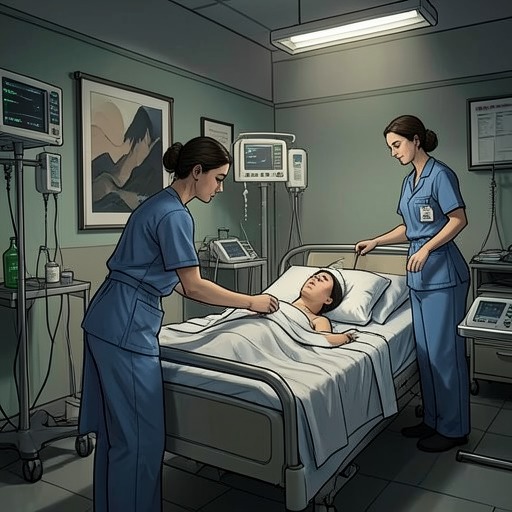
In Kinshasa, Sister M.E. was admitted to Ngaliema Hospital, a private hospital run by Swedish nurses, and placed in a room of her own. Her transfer did not lead to recovery. As she approached death, her doctors still did not know which agent was responsible, but they suspected a Marburg-like disease. Her case thus joined the local outbreak to the wider medical effort to identify an unfamiliar and dangerous infection.
Samples and investigation
Because Sister M.E.’s religious order prohibited autopsies, doctors sought information through an agonal biopsy, a rapid tissue sample taken near the time of death. During her terminal illness, they inserted a needle into her upper abdomen and drew liver tissue into a syringe. They also collected blood in glass tubes. The procedure was an attempt to learn what was replicating inside her without conducting a full autopsy; it made her body the source of evidence at the same moment that the cause of her illness remained uncertain.
The samples were sent to laboratories in Belgium and England, including the Microbiological Research Establishment at Porton Down. Scientists there began trying to identify the agent. At the Centers for Disease Control and Prevention in Atlanta, Karl M. Johnson and his colleagues were initially receiving little reliable information about events upriver. They knew only that people in Zaire were dying of a fever with generalized symptoms, and they were trying to obtain some of Sister M.E.’s blood for examination.
A shipment eventually reached the Centers for Disease Control and Prevention, but the glass tubes had broken in transit and blood had leaked inside the package. Patricia Webb, a virologist, opened it wearing rubber gloves and recovered a small amount for testing. She put droplets into flasks containing monkey cells; the cells became sick and died, showing that the unknown agent could infect them. In this way, material collected during Sister M.E.’s final illness became part of the laboratory work that transformed an obscure outbreak into an object of scientific investigation. The evidence here records the beginning of that testing, rather than attributing a final identification to her case alone.
Death and narrative significance
After Sister M.E.’s body was taken away for burial, the bloodstained room at Ngaliema Hospital remained closed for days. Staff feared entering to clean it, and the room became a stark measure of how little they knew about the disease and how dangerous they believed contact with its traces might be. Her death also sharpened the urgency of the investigation: doctors had obtained samples, but the disease’s identity and means of spread were still unresolved.
Sister M.E. is presented neither through a developed biography nor through personal testimony. Instead, the account follows the institutional and material consequences of her illness: a transfer from Yambuku to Kinshasa, a room left unused, a biopsy syringe and blood tubes, and specimens sent across borders for testing. Her story shows how a patient could become a crucial source of evidence without the narrative claiming that she chose that role or that investigators had already solved the mystery. The transition from her bedside to the laboratories also links care and research under outbreak conditions: the attempt to treat her and the effort to understand the virus proceeded together, while uncertainty persisted.